You’ve probably heard people say that “music makes you smarter,” but if you’re a parent, this might sound a bit too good to be true. Is there actually any science behind it?
The answer is yes, and the results are more remarkable than you might expect. Research from multiple universities has found that piano students show measurable cognitive improvements, with some studies reporting IQ gains. But IQ scores are just scratching the surface.
Neuroscience has revealed something fascinating: learning to play the piano doesn’t just teach your child a skill, it physically reshapes their brain. It stimulates neuroplasticity, the brain’s ability to reorganise itself by forming new connections. While brains remain adaptable throughout life, the window between ages 4 and 7 is particularly powerful for this kind of development.
Here are five surprising ways piano lessons physically structure your child’s brain for success.
1. Strengthens the “Bridge” Between Brain Hemispheres
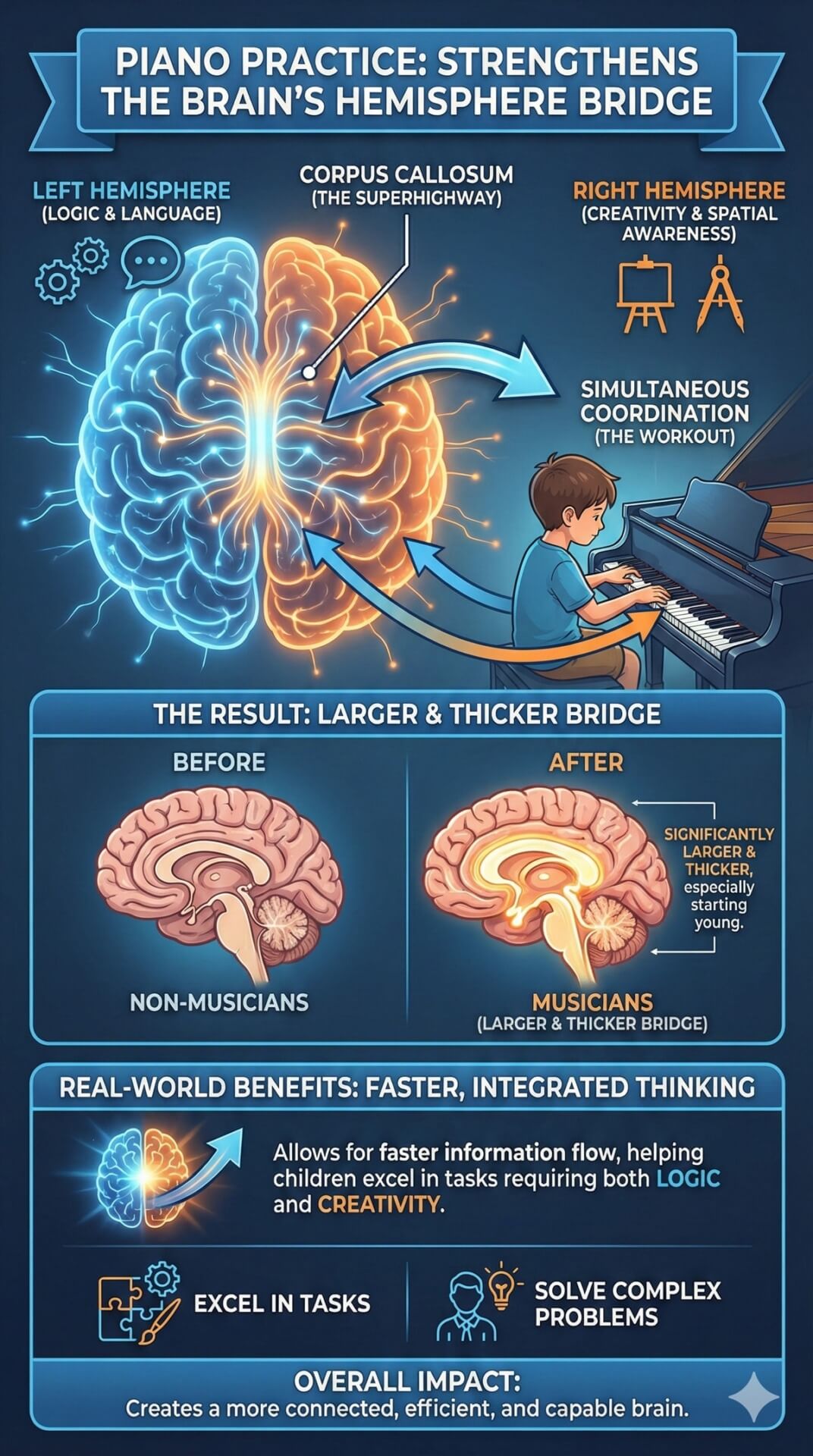
The human brain is divided into two hemispheres: the left (often linked with logic and language) and the right (linked with creativity and spatial awareness). Connecting these two sides is a bundle of nerve fibres called the corpus callosum.
Think of the corpus callosum as a superhighway for information. Because piano playing requires a child to coordinate the left hand (controlled by the right brain) and the right hand (controlled by the left brain) at the same time, this bridge gets a serious workout.
The result: Research shows that musicians develop a significantly larger and thicker corpus callosum, particularly when they start young. This allows for faster, more integrated thinking, helping children excel in tasks that require both logic and creativity to solve.
2. Creates Rapid Neural Pathways for Memory & Retention
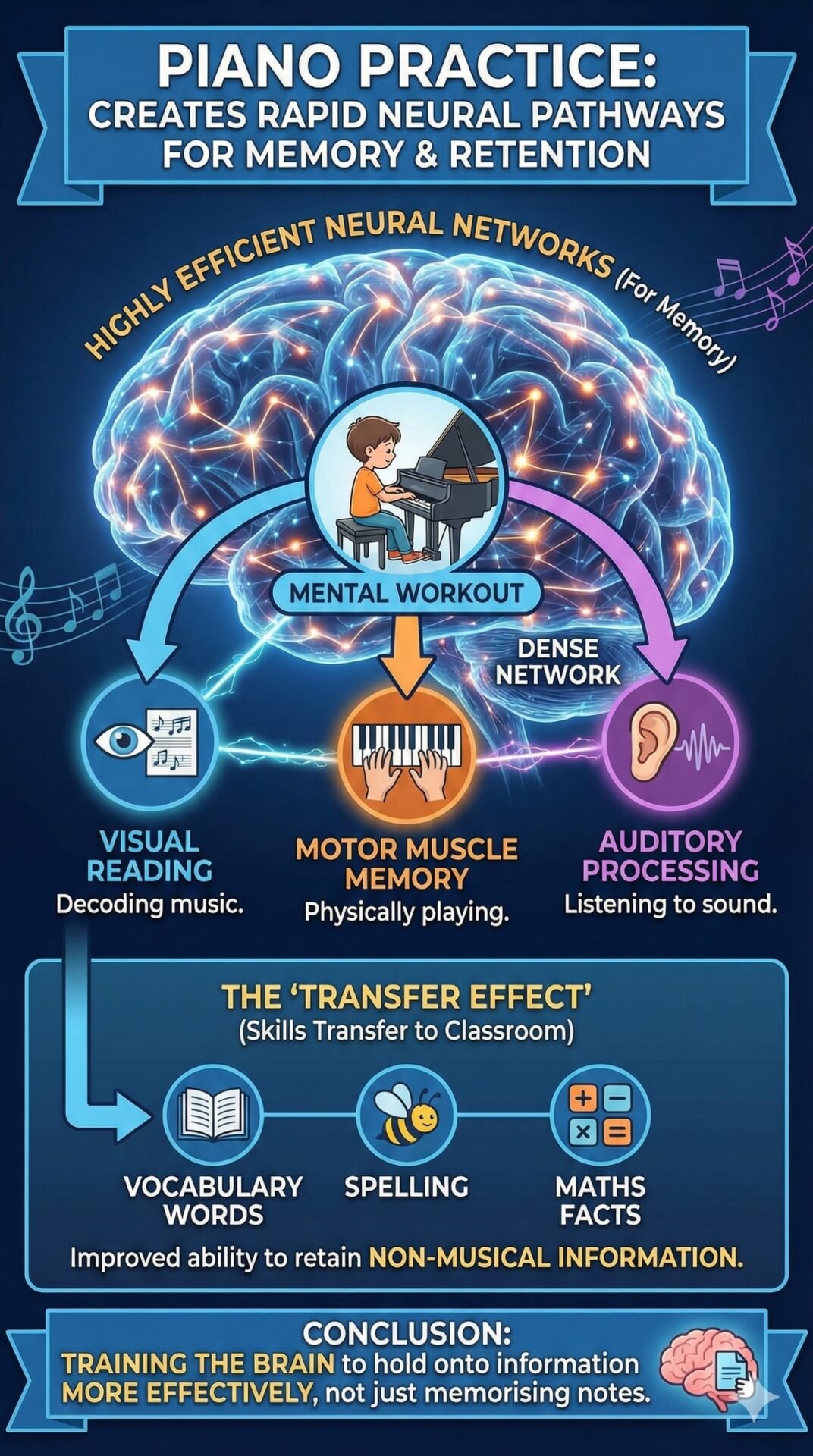
Have you ever wondered how a pianist can memorise pages of complex music? It’s because music training creates highly efficient neural networks for memory.
Playing piano is a mental workout that combines visual reading, motor muscle memory, and auditory processing all at once. This creates a dense network of connections in the brain. Scientists call this the “transfer effect.” The memory skills honed at the keyboard don’t stay there; they transfer to the classroom.
Children with piano training consistently show improved ability to retain non-musical information, such as vocabulary words, spelling, and maths facts. They aren’t just memorising notes; they’re training their brains to hold onto information more effectively.
3. Enhances Fine Motor Development & Body Awareness
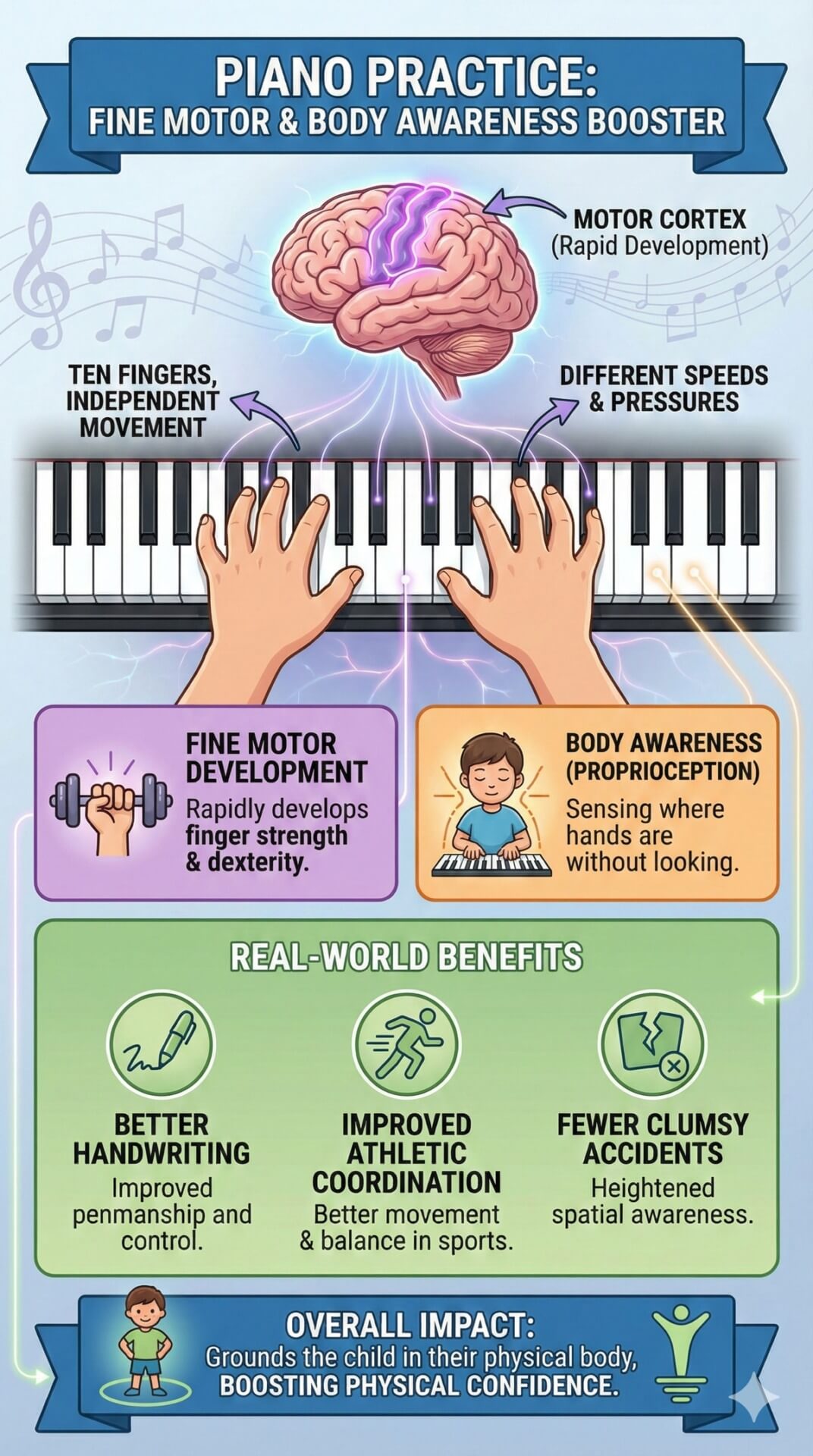
Piano is one of the few activities that requires ten fingers to move independently at different speeds and pressures. This develops the motor cortex of the brain rapidly.
But it goes deeper than just finger strength. It develops proprioception, the body’s ability to sense where it is in space without looking. A pianist must know where the keys are without constantly staring at their hands.
The benefit: This heightened body awareness translates to better handwriting, improved athletic coordination, and fewer clumsy accidents. It grounds the child in their physical body, boosting their physical confidence.
4. Boosts Executive Function & Attention Span
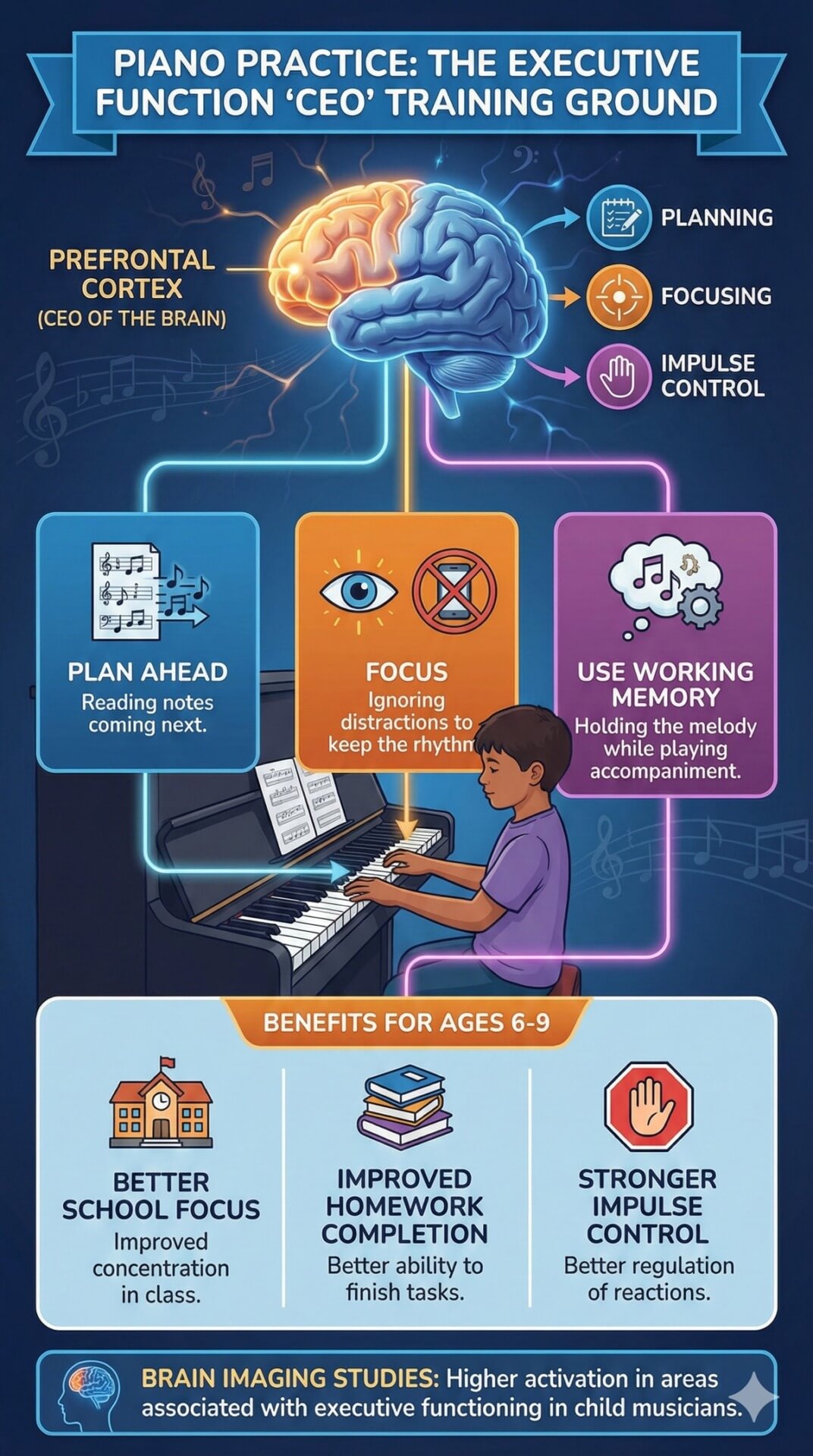
Executive function acts as the “CEO” of the brain. It handles planning, focusing, and impulse control, and it lives in the prefrontal cortex, an area that’s crucial for academic and life success.
Piano practice is essentially a training ground for executive function. To play a piece, a child must:
- Plan ahead (reading the notes coming next)
- Focus (ignoring distractions to keep the rhythm)
- Use working memory (holding the melody in their head while playing the accompaniment)
Especially for children aged 6 to 9, piano strengthens the prefrontal cortex, leading to better focus in school, improved ability to finish homework, and stronger impulse control. Studies using brain imaging have shown higher activation in areas associated with executive functioning in child musicians.
5. Rewires the Brain for Emotional Processing & Resilience
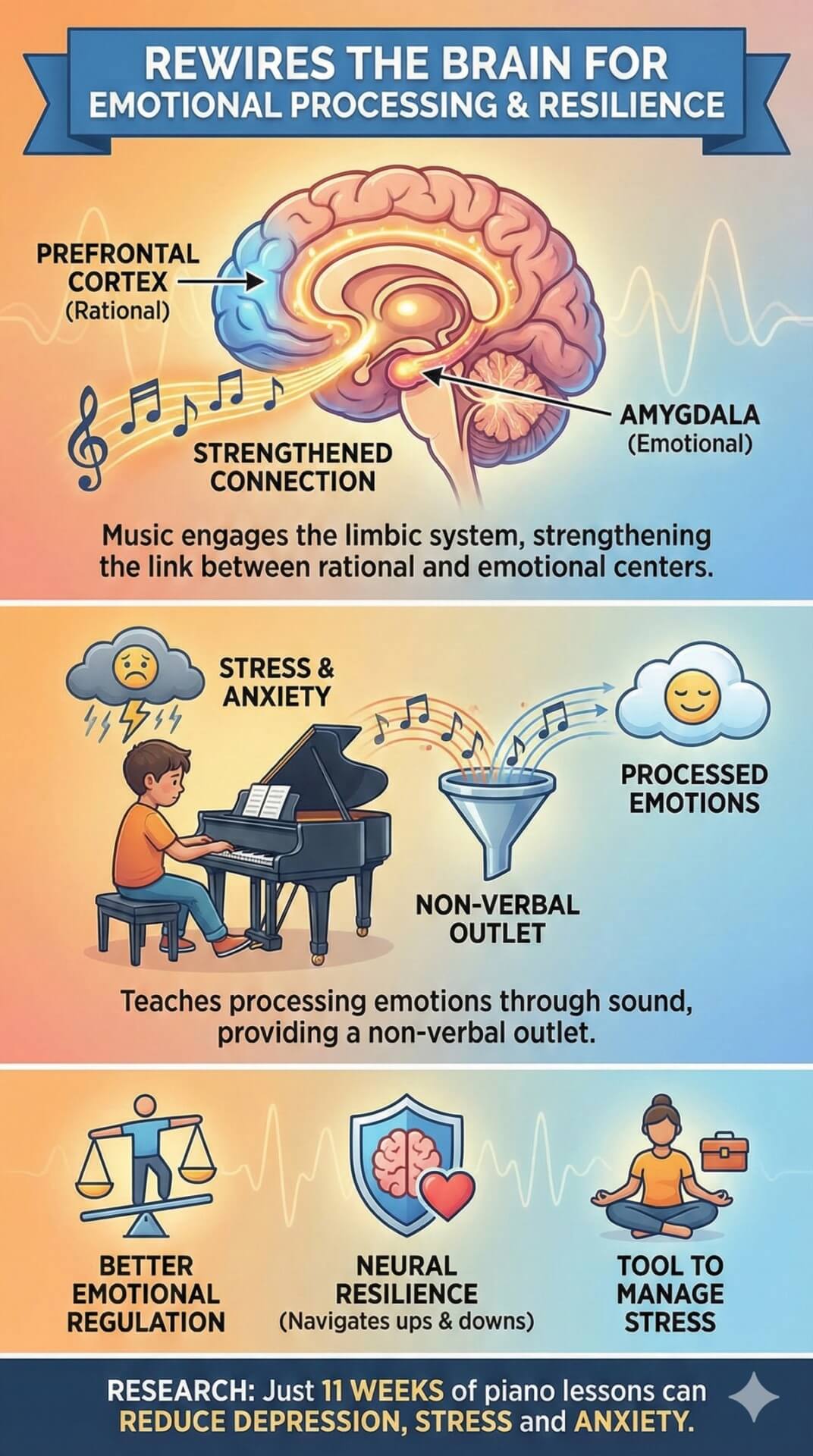
Finally, the benefits aren’t just cognitive; they’re emotional too. Music engages the limbic system, the brain’s emotional centre.
Learning to play piano teaches a child to process emotions through sound. It provides a non-verbal outlet for stress and anxiety. Neurologically, this strengthens the connection between the rational prefrontal cortex and the emotional amygdala.
The result: Children who play music are often better at regulating their emotions. They have a tool to manage stress, creating a form of “neural resilience” that helps them navigate the ups and downs of growing up. Research has shown that just 11 weeks of piano lessons can reduce depression, stress and anxiety.
The Window of Opportunity
While the brain benefits from music at any age, the potential for development is most active in childhood. Starting your child on their musical journey now isn’t just about songs; it’s about building a better brain for life.
Discover how piano can unlock your child’s full cognitive potential. Explore our lessons at Little Play Space and give your child the gift of a stronger, more resilient brain.