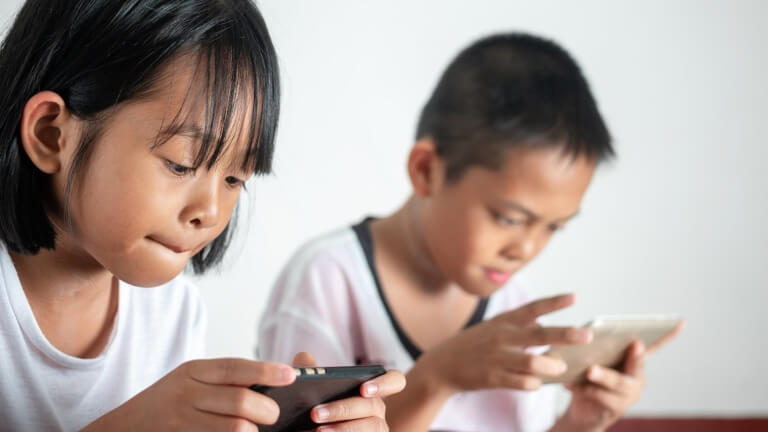
If you’re a parent today, you know this battle intimately. You ask your child to turn off the tablet, and the entire mood shifts in seconds. You’re not imagining it, and you’re certainly not alone: research shows that parents spend roughly 96 hours every year arguing with their kids about screen time, which works out to more than one conflict per day.
The numbers are genuinely worrying. Children aged 8 to 12 now clock an average of nearly 5 hours of entertainment screen time daily. As parents, we carry the guilt and fear of addiction, but we also feel stuck. Nobody wants to be the constant “screen police,” confiscating devices and nagging endlessly. What we really want is to give our children something meaningful to turn towards instead.
What if the solution wasn’t stricter rules, but finding an activity so engaging that your child actually chooses it over the iPad?
Piano lessons offer exactly that: a unique, powerful antidote to screen dependency. It’s not just another hobby; it’s a lifestyle shift that naturally crowds out digital distractions. Here are five ways piano classes can help you reclaim your child’s time and attention.
1. Creates a Structured Daily Rhythm
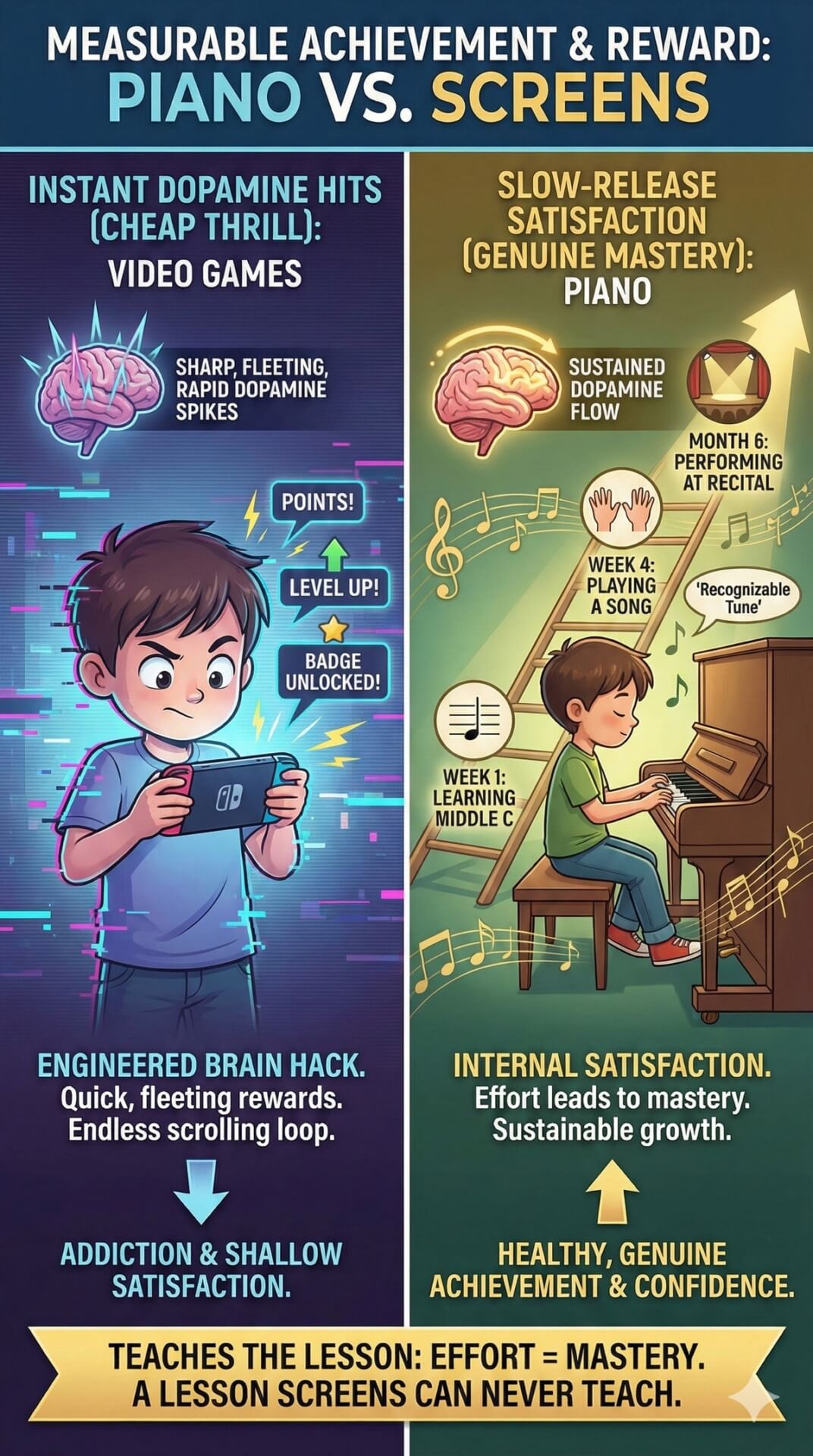
Screen addiction thrives in those “in-between” moments, the dead time after school or before dinner when a child grabs a device simply because they’re bored. Piano practice replaces that automatic reflex with a structured, purposeful routine.
Unlike a sport that might happen twice a week, piano requires daily engagement. Even a short commitment of 15 to 20 minutes creates a consistent rhythm in your child’s day. When “piano time” becomes as fixed as brushing teeth, it removes the decision fatigue of “what should I do now?” and fills that void before screens even enter the picture.
Parental tip: Frame this not as a chore, but as a family rhythm. By establishing this habit, you’re using positive reinforcement to create lasting behaviour change, rather than relying on the negativity of constantly taking screens away.
2. Offers Deep, Active Engagement (The “Flow State”)
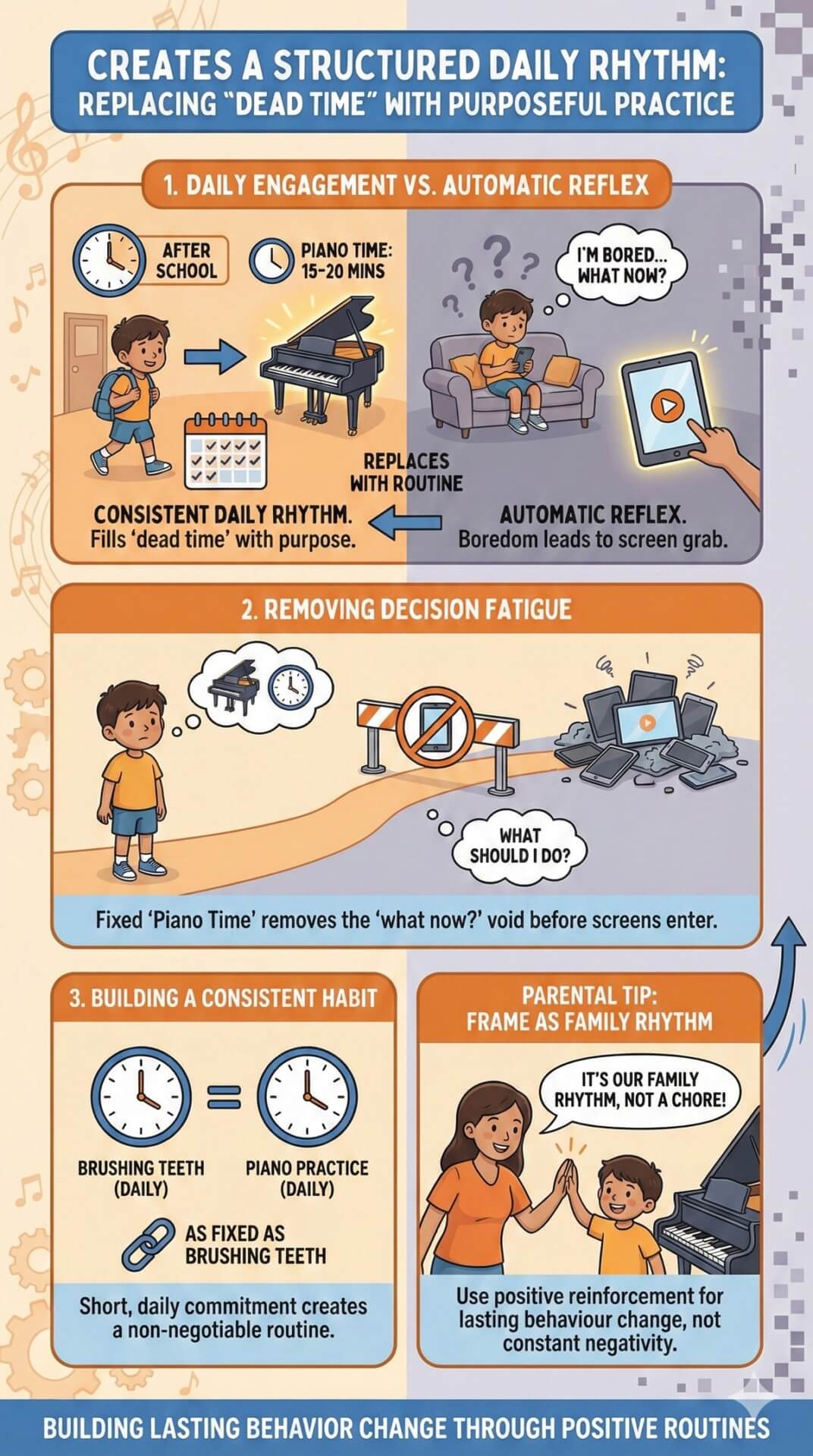
One big reason screens are so addictive? They’re passive. They wash over the brain without requiring real effort. Piano is the complete opposite: it demands active engagement.
To play the piano, a child must use their eyes (reading music), their ears (listening to pitch), and their hands (motor coordination) all at once. Multitasking is impossible at the keys. This level of focus creates what psychologists call a “flow state,” a mental zone of immersed concentration where time seems to disappear.
Research on professional pianists shows that playing music induces a genuine flow experience with measurable neurological satisfaction that passive screen consumption simply cannot replicate. When your child is deep into a song, they’re not thinking about their iPad because their brain is fully engaged in the real world.
3. Provides Measurable Achievement & Reward
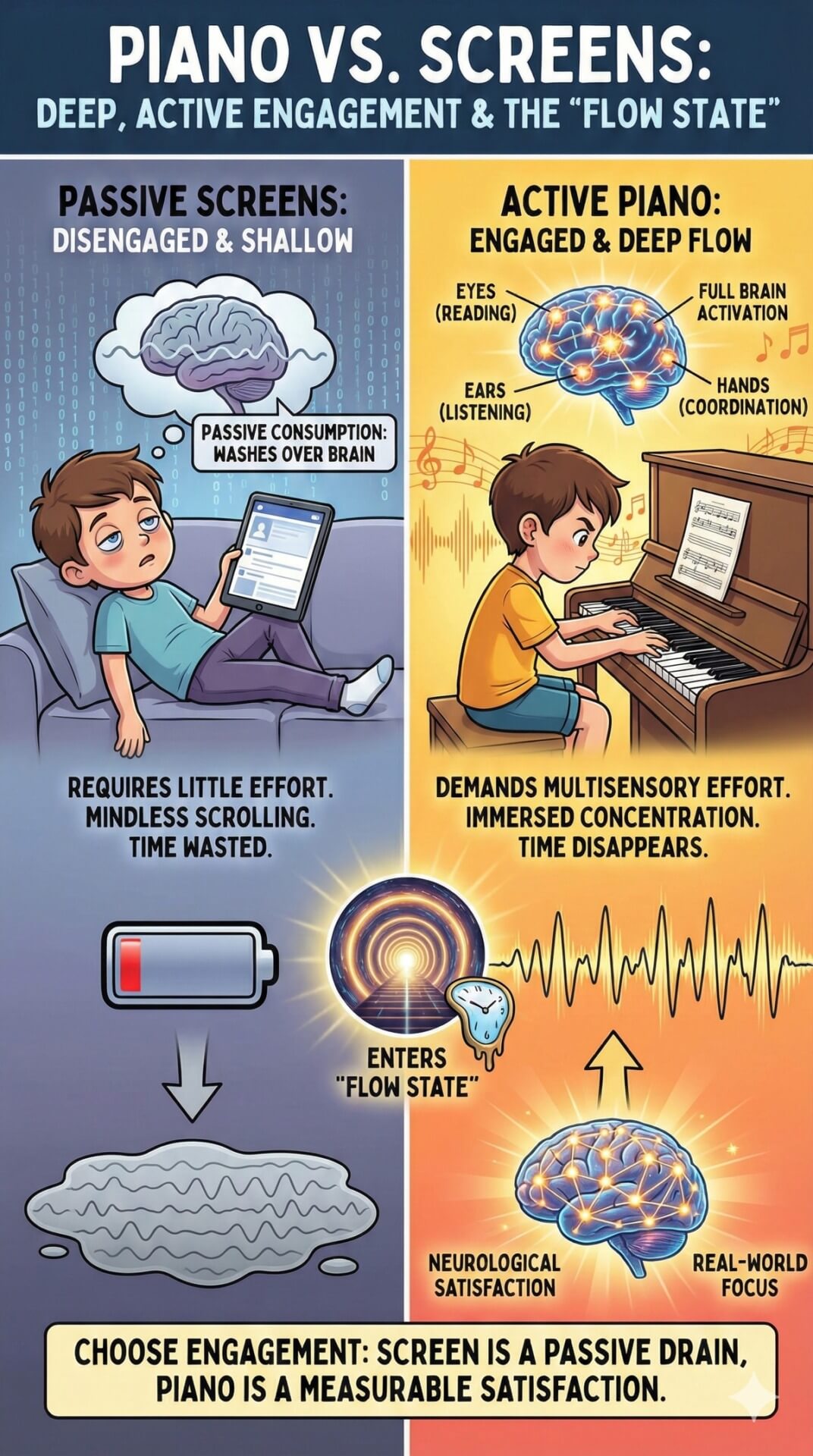
Video games are engineered to hack the brain’s reward system with instant dopamine hits: points, levels, badges. To compete with this, a child needs an offline activity that provides genuine achievement.
Piano offers a clear, visible progression ladder:
- Week 1: Learning middle C
- Week 4: Playing a recognisable song with two hands
- Month 6: Performing at a recital
The internal satisfaction of mastering a difficult piece provides a “slow-release” dopamine that’s far healthier and more sustainable than the cheap thrill of levelling up in a game. It teaches children that effort leads to mastery, a lesson that endless scrolling can never teach.
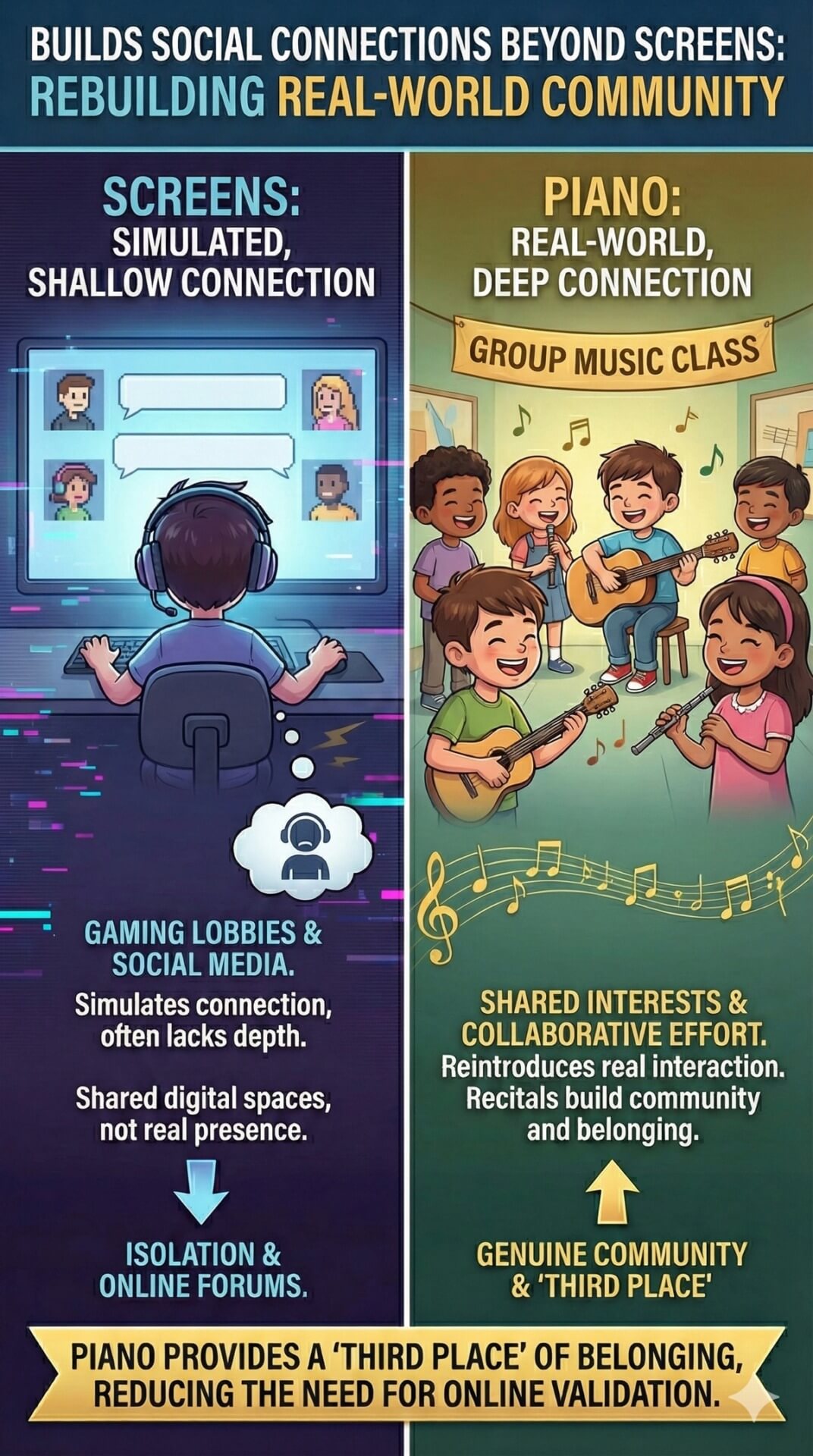
4. Builds Social Connections Beyond Screens
For many children, screens are their primary way of socialising. Gaming lobbies and social media chats simulate connection, but they often lack depth.
Piano classes, particularly group sessions or ensemble playing, reintroduce real-world social interaction. In a group music class, children make friends based on shared interests and collaborative effort, not just shared digital spaces. Preparing for a recital with peers builds a genuine sense of community and belonging.
When a child has a “third place” outside of home and school where they feel they belong, like a music school, they have less need to seek that connection in online forums.
5. Creates a Healthy Alternative That Becomes the Preference
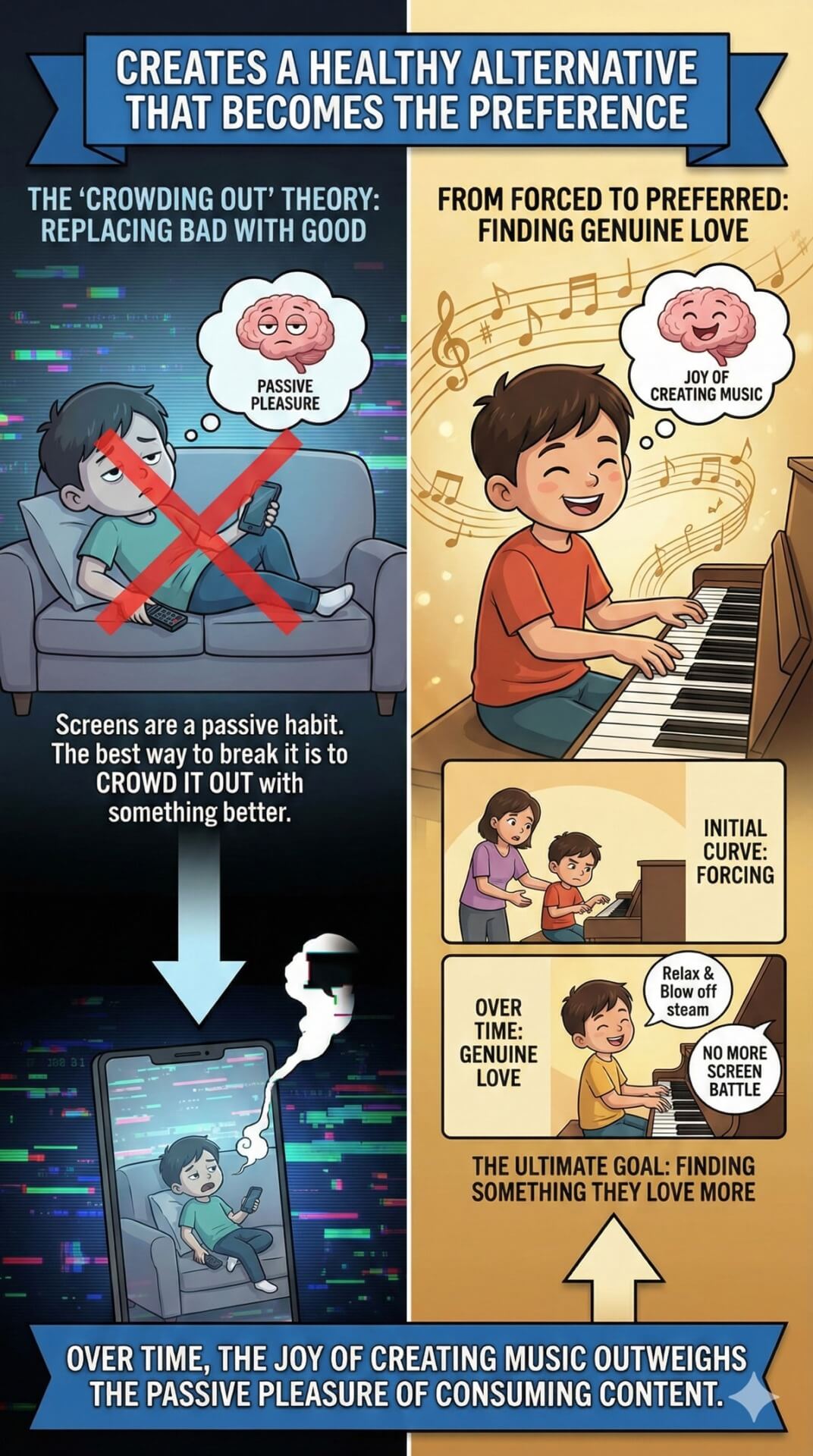
The ultimate goal isn’t forcing your child to play piano; it’s helping them prefer it.
The “crowding out” theory suggests that the best way to break a bad habit is to replace it with a good one. Over time, as your child improves at the piano, the joy of creating music begins to outweigh the passive pleasure of consuming content.
We’ve seen countless students who, after the initial learning curve, begin sitting at the piano to relax or blow off steam instead of reaching for the remote. They stop fighting the screen battle because they’ve found something they genuinely love more.
Ready to Reset Your Child’s Habits?
You don’t have to fight the screen time war alone. By introducing piano, you’re not taking something away from your child, you’re giving them a lifelong gift of creativity, focus and joy.
Ready to help your child discover a screen-free passion? Explore our classes at Little Play Space and watch them find something they love more than the iPad.