Picture this: dinner is done, homework is “finished”, and the house suddenly goes very quiet. Too quiet. You walk into the living room and there’s your child, slumped on the sofa, face lit by the blue glow of a tablet, totally zoned out. You ask them to switch it off… and the argument starts all over again.
Most parents want the same things: kids who are curious, creative, focused and happy. Yet so much of their free time gets swallowed up by endless scrolling and gaming. What if there was something just as engaging as a screen – but instead of draining their attention, it sharpened it?
Piano lessons are not just about playing Mozart or making it through “Happy Birthday” at a family party. Learning the piano can boost brain development, build emotional resilience, and – perhaps most appealing for modern parents – offer a fun, natural way to reduce screen time without constant nagging.
Why Screen Time Is So Hard To Compete With

If it feels like you are constantly wrestling devices out of your child’s hands, you are far from alone. Many children now clock up hours of screen time every day – in some cases, close to the equivalent of a full‑time job.
Screens themselves are not “bad”, but too much passive screen time is linked with shorter attention spans, sleep issues and emotional ups and downs in growing children. Apps and games are designed to deliver instant rewards for very little effort, which makes real‑world tasks like homework or chores feel slow and boring by comparison.
There is also the question of opportunity cost: every extra hour on a device is an hour not spent moving their body, using their hands, solving problems, or learning to focus deeply on a single task. So the goal is not just to “ban” screens, but to give children something genuinely better to do with part of that time.
Piano vs. Passive Scrolling
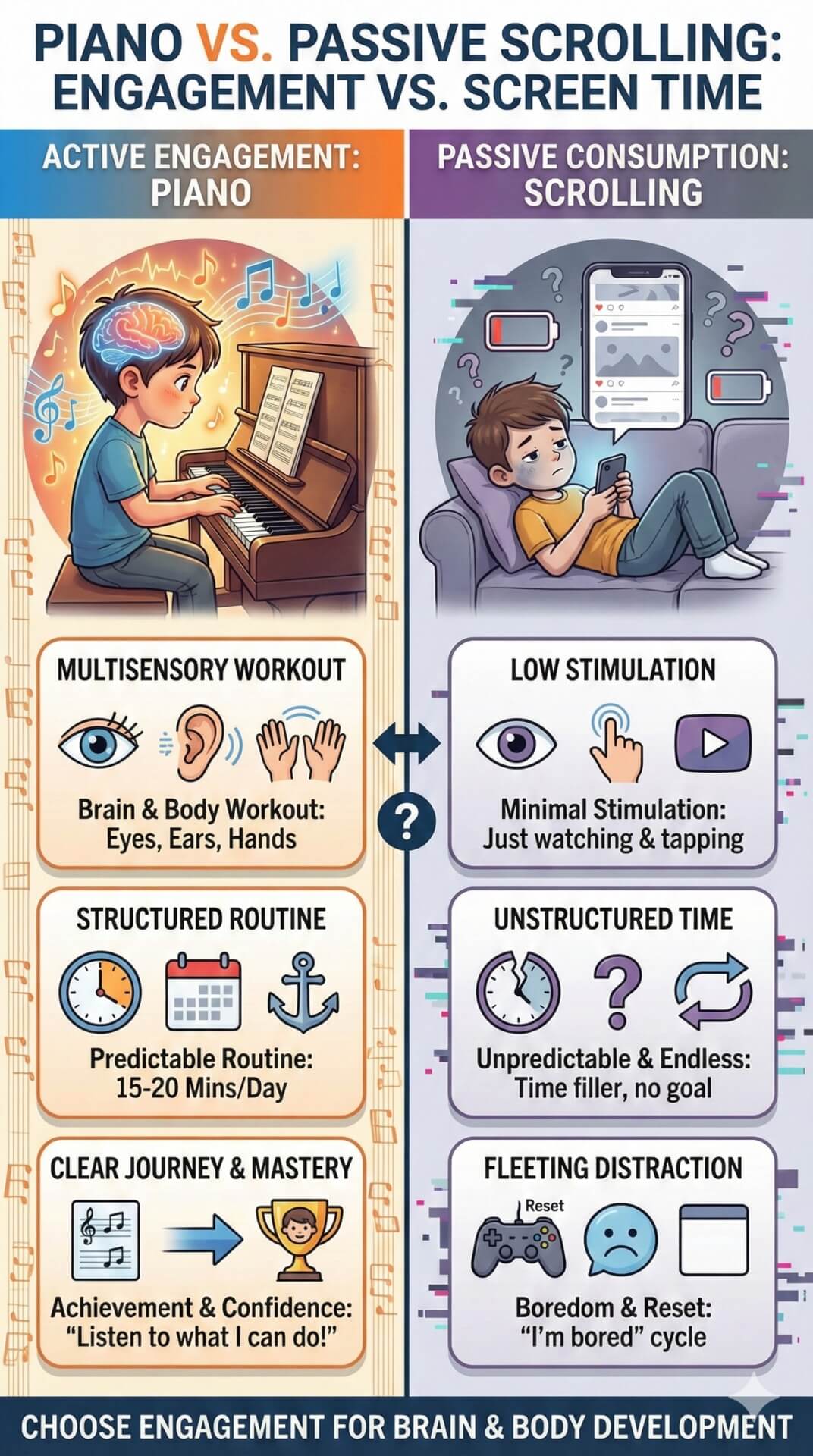
For any activity to compete with a tablet or phone, it has to be genuinely engaging. This is exactly where the piano stands out.
Playing the piano is an active workout for the brain and body. At the keyboard, your child is reading notes with their eyes, listening carefully with their ears, and coordinating ten fingers across the keys – sometimes doing completely different things in each hand. This kind of multisensory involvement is far more stimulating than simply watching a video or tapping a screen.
Piano also brings structure into a child’s day. Just 15–20 minutes of practice becomes a predictable, device‑free routine, especially if it happens at the same time each day. Unlike a game that resets with every level, a song they are learning has a clear journey: from those first clumsy attempts to the moment they can finally play it through with confidence. Instead of “I’m bored”, they start to think, “Listen to what I can do.”
What Piano Does Inside The Brain
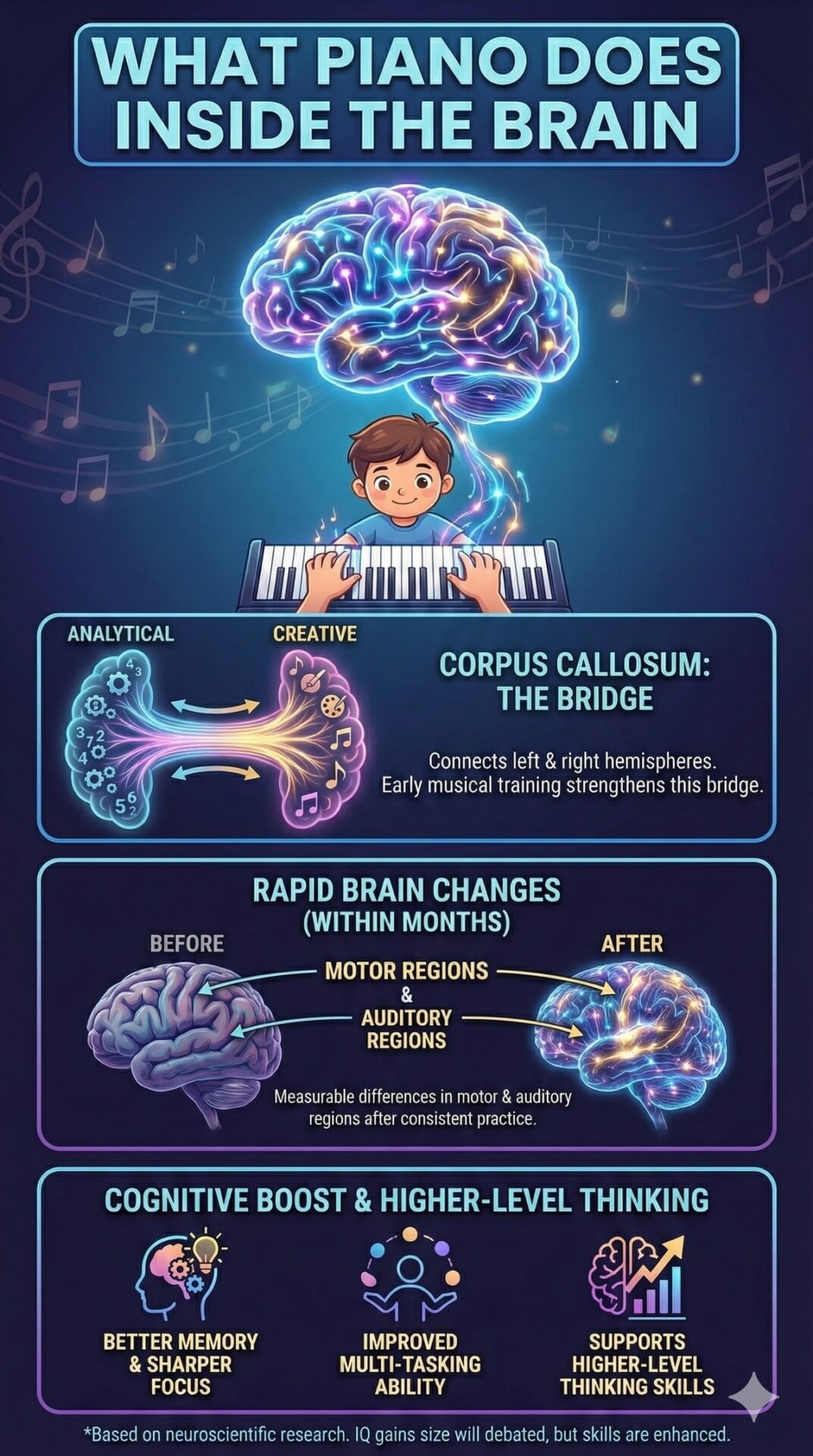
The biggest reason to consider piano lessons actually happens where you cannot see it – inside your child’s brain. Neuroscientists have found that learning an instrument is one of the rare activities that lights up almost every major area of the brain at once.
One key area is the corpus callosum, the bundle of nerve fibres that connects the left and right hemispheres. Studies show that children who start musical training early, particularly before around age seven, often develop stronger connections across this “bridge”, making communication between the analytical and creative sides of the brain more efficient.
Changes can be seen surprisingly quickly. Research has found measurable brain differences after just months of consistent musical practice, including stronger connections in motor and auditory regions. These changes are linked with better memory, sharper focus and improved ability to juggle several mental tasks at once. While scientists still debate the exact size of IQ gains, multiple reviews agree that music training supports higher‑level thinking skills.
How Piano Supports Schoolwork
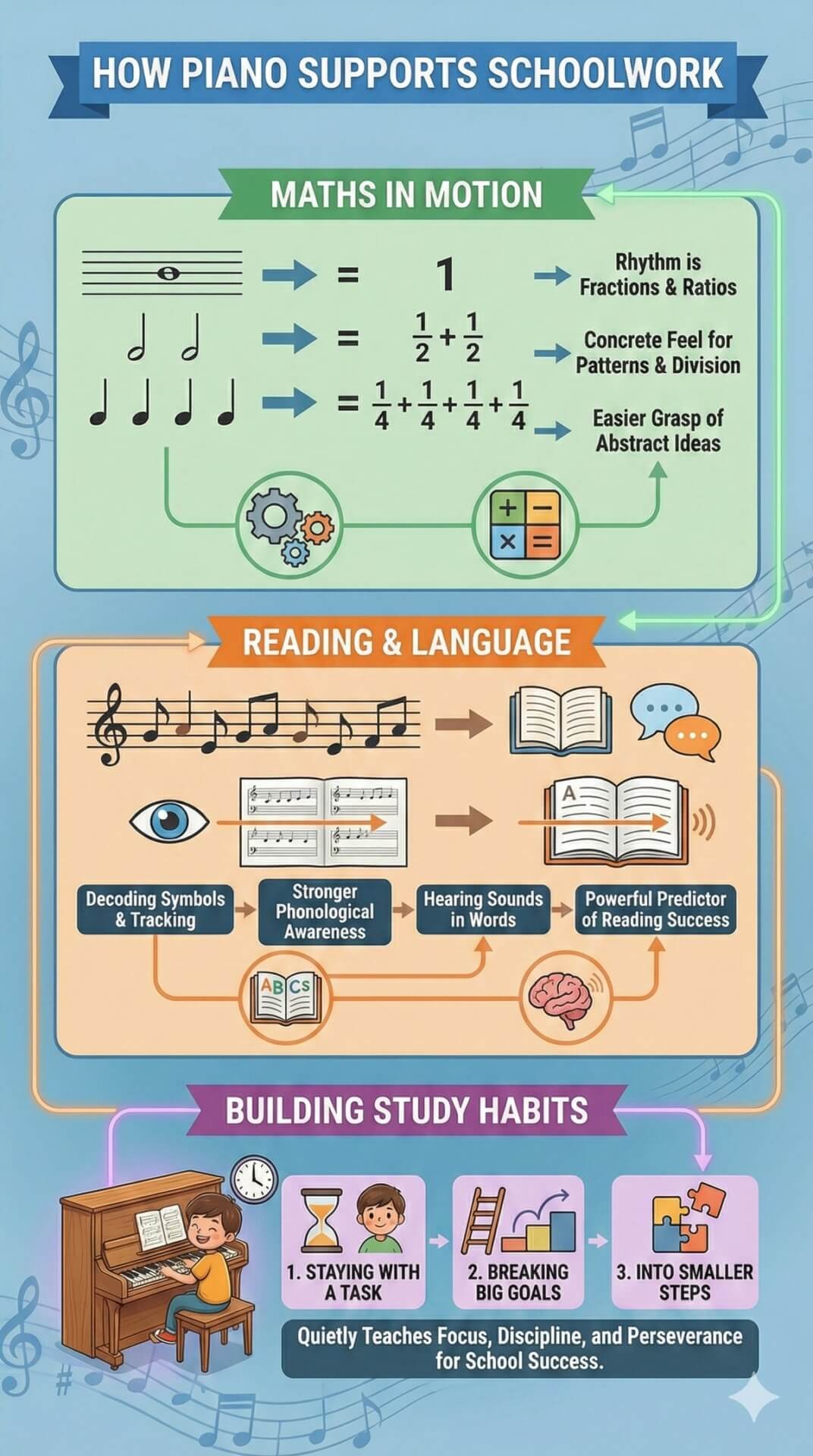
When your child is practising scales, they are not just working on music – they are training the same mental skills used in maths and reading.
- Maths in motion: Rhythm is built on fractions and ratios, even if children do not call them that yet. Whole notes, halves, quarters and time signatures give them a concrete, physical feel for numbers, patterns and division. Kids who study music often find it easier to grasp abstract maths ideas because they have already experienced them in sound.
- Reading and language: Reading music uses similar brain systems to reading text: decoding symbols, tracking from left to right, and turning those symbols into action. Children with musical training often show stronger phonological awareness – the ability to hear and play with the sounds inside words – which is a powerful predictor of reading success.
On top of specific subjects, piano quietly teaches the habits that help children do well at school: staying with a task, breaking big goals into smaller steps, and accepting guidance from a teacher. The stamina it takes to polish a tricky piece is the same stamina needed to work through a challenging maths problem or long reading passage.
Emotional Benefits: A Safe Space On The Bench
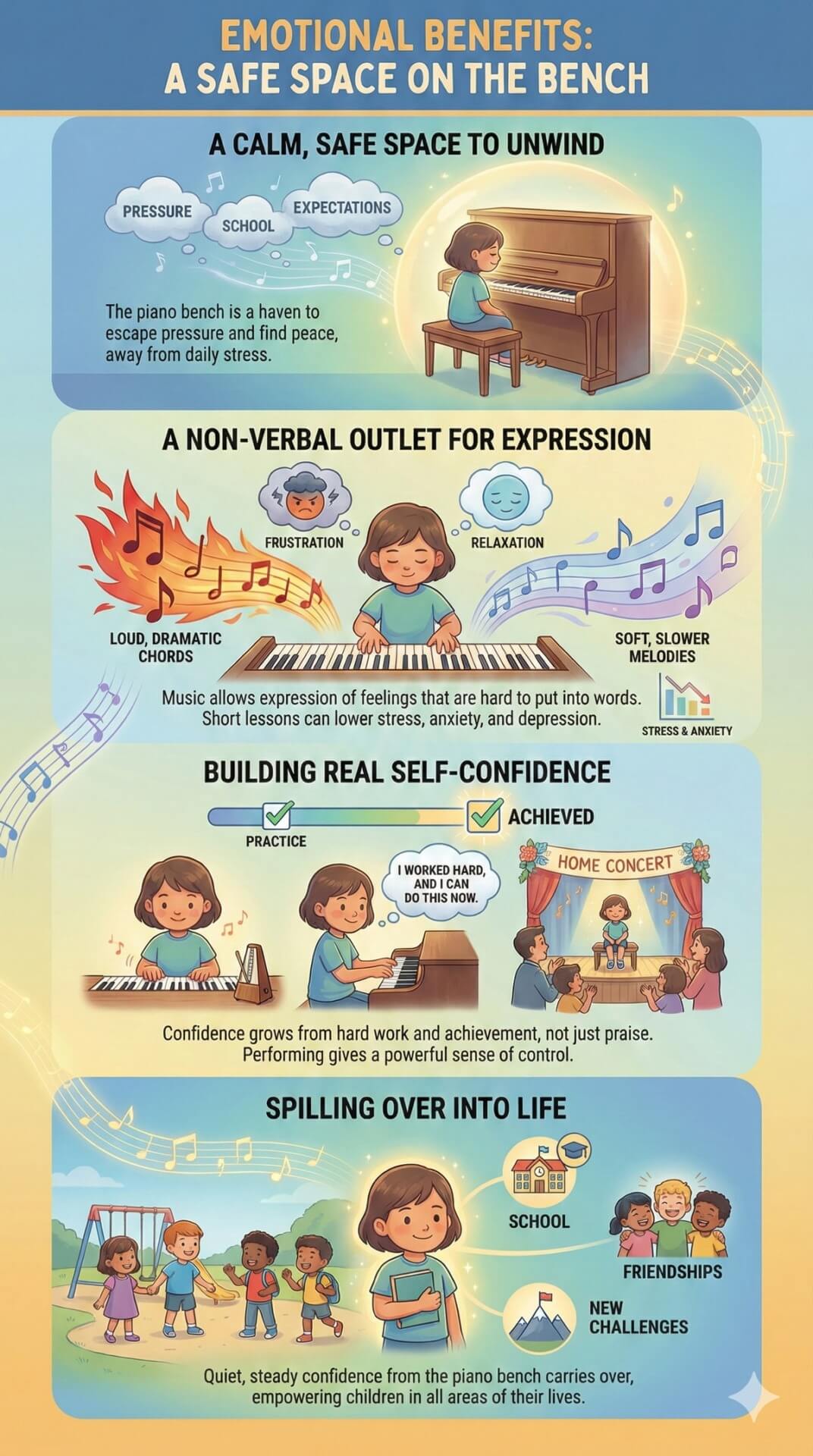
Modern kids feel a lot of pressure – from school, friendships, and sometimes from their own expectations. The piano bench can become a calm, safe space where they can unwind and express feelings that are hard to put into words.
Music gives children a non‑verbal outlet. They might play loud, dramatic chords when they are frustrated, or something softer and slower when they need to relax. Studies have shown that even a relatively short period of piano lessons – as little as 11 weeks – can lower levels of stress, anxiety and depression.
Piano also builds real self‑confidence. Confidence grows not from being told “You’re amazing!” but from seeing, “I worked hard, and I can do this now.” Performing a piece they have practised – whether it is at a small home “concert” or at a formal recital – gives children a powerful sense of achievement and control. That quiet, steady confidence often spills over into school, friendships and new challenges.
How To Get Your Child Started
If you are thinking of introducing piano to your child, a few simple decisions at the beginning can make the journey smoother and more enjoyable.
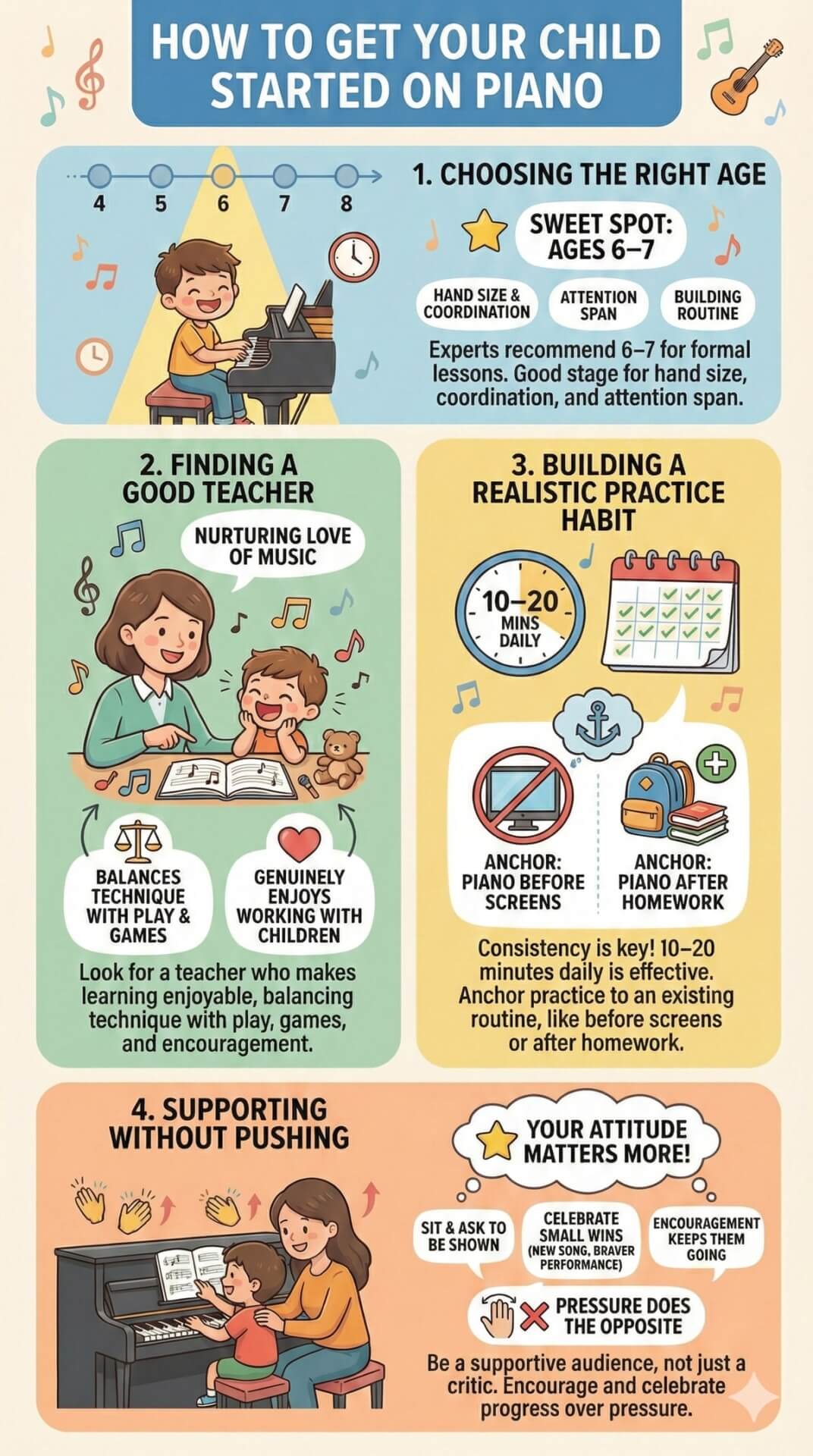
1. Choosing the right age
Children can begin exploring music very young, but for more formal piano lessons, many experts see ages 6 – 7 as a “sweet spot”. At this stage, most kids have the hand size, coordination and attention span to follow a teacher and build a basic practice routine.
2. Finding a good teacher
Look for a teacher who genuinely enjoys working with children and can balance proper technique with play, games and encouragement. The aim is not just perfect posture and finger position; it is nurturing a love of music so your child actually wants to keep learning.
3. Building a realistic practice habit
Little and often works far better than rare, long sessions. Even 10–20 minutes a day can make a big difference if it is consistent. Many parents find it helpful to anchor practice to something that already happens every day – for example, “piano time before any screens” or “piano right after homework”.
4. Supporting without pushing
Your attitude matters more than perfect musical knowledge. Sit with your child sometimes, ask them to show you what they learned, and celebrate small wins: a new song, a smoother transition, a braver performance. Encouragement keeps them going; pressure usually does the opposite.
A Small Daily Habit With Lifelong Payoff
Piano lessons are an investment that goes far beyond music. Swapping just 15–20 minutes of screen time for piano practice each day does more than reduce device dependency – it helps your child build a stronger, more flexible brain. Along the way, they gain emotional tools, discipline and confidence that will stay with them long after the last note fades.
The aim is not necessarily to raise a concert pianist. The real goal is to help your child grow into a capable, well‑rounded and genuinely happy person – and piano can be a beautiful, practical way to support that journey.
Ready to unlock your child’s potential?
If you are ready to see what a difference music can make, consider booking a low‑pressure trial class for your child and watching how they respond at the keys. You might be surprised by how quickly their focus, mood and confidence begin to change – and how easily a little less screen time follows.