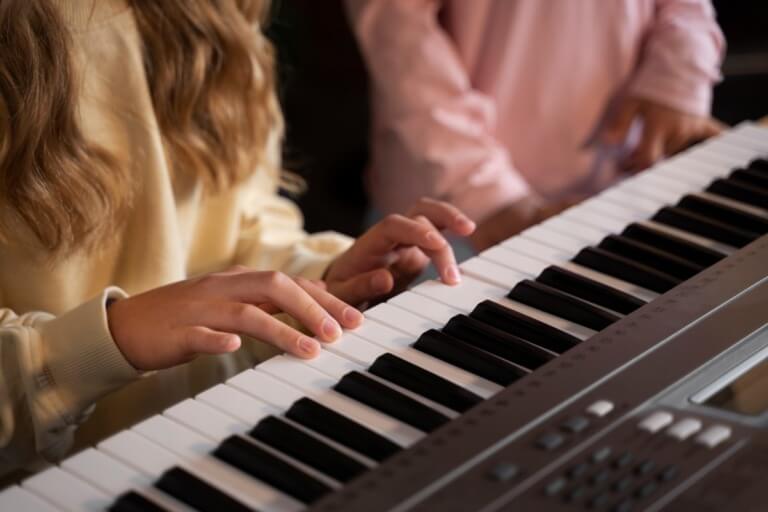
As parents, we often feel like we’re chopping our child’s development into pieces. We send them to football for their body. We send them to tutoring for their mind. We hope school handles the rest.
But children aren’t made of separate parts. They’re whole beings.
What if there was one activity that nurtured the whole child, body, mind, and soul, all at once? Piano is that rare pursuit. It’s a “triple threat” for child development.
Body: Physical Mastery
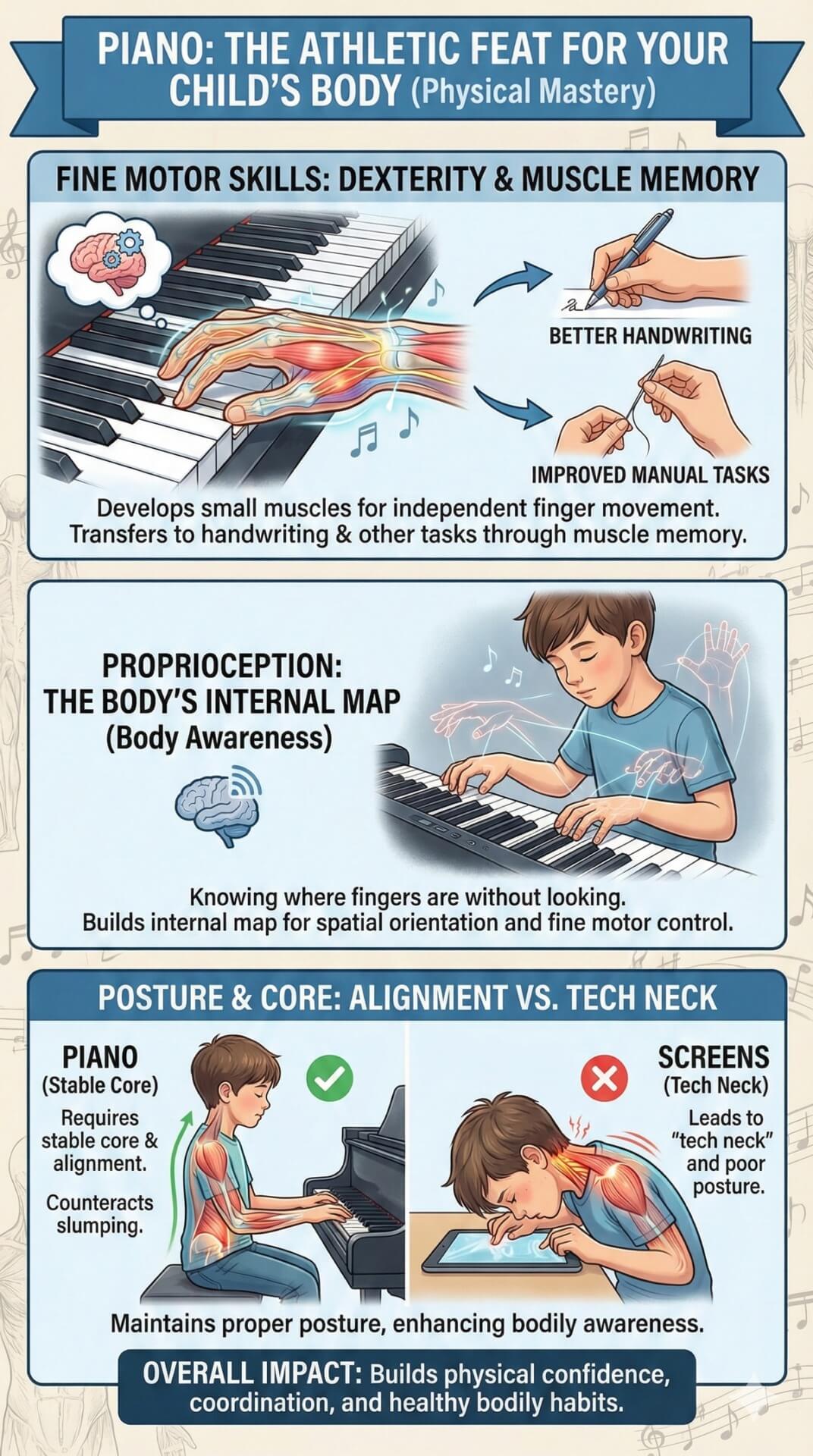
We don’t often think of music as physical, but piano playing is genuinely an athletic feat for the hands.
Fine motor skills: Independent finger movement develops the small muscles in the hand and wrist. This dexterity transfers directly to handwriting and other manual tasks. The repetitive practice inherent in learning an instrument hones motor skills through consistent refinement and muscle memory.
Proprioception: This is “body awareness,” knowing where your fingers are without looking. Piano builds this internal map of the body. Heightened proprioceptive awareness enhances spatial orientation and fine tunes motor control, laying the foundation for skilled musical performance.
Posture and core: Proper playing requires a stable core and relaxed shoulders. It teaches a child to sit with alignment and balance, counteracting the “tech neck” slump of screen time. The discipline of maintaining proper posture and finger technique enhances bodily awareness.
Mind: Cognitive Excellence
The research is clear: music makes minds sharper.
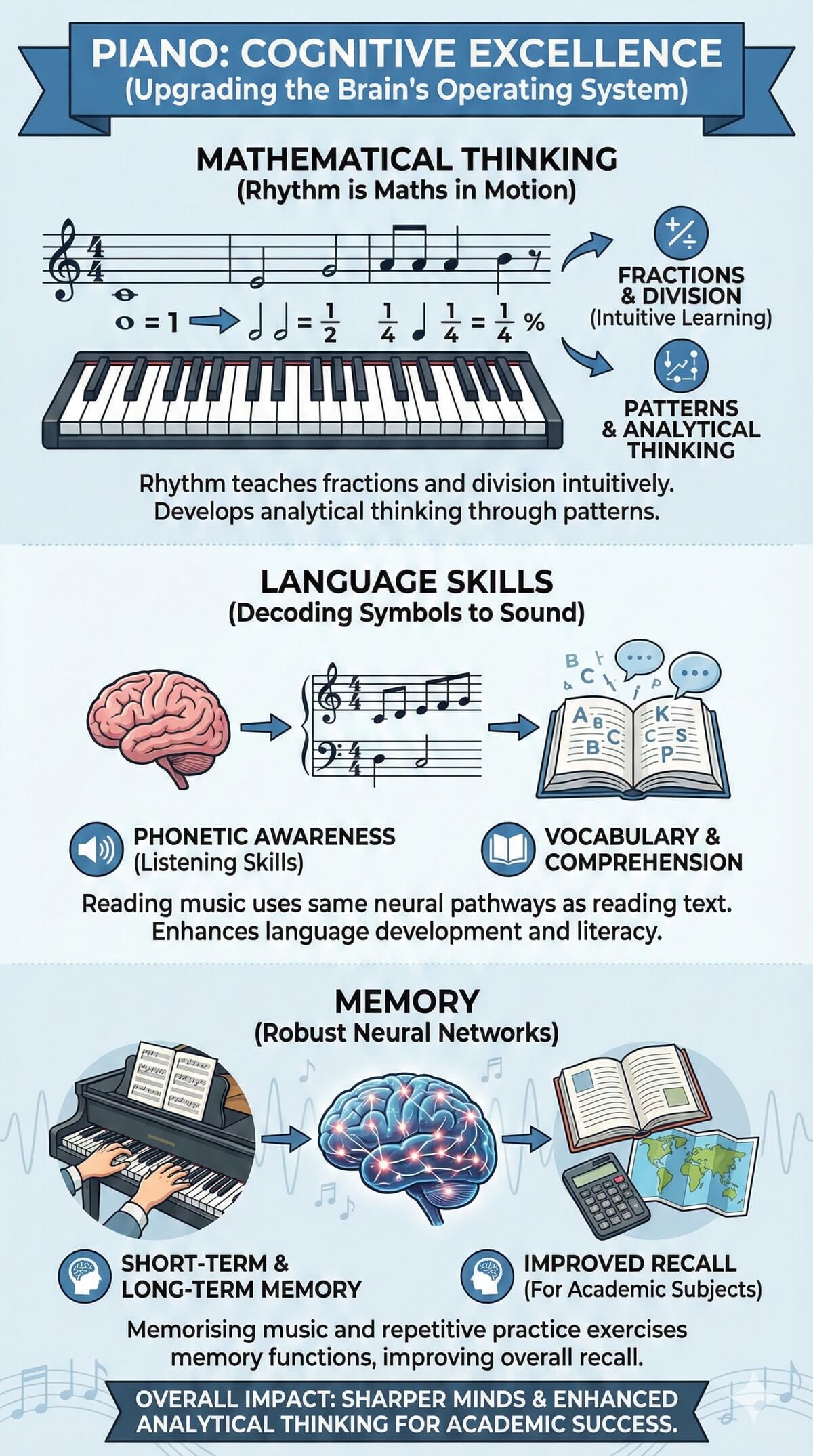
Mathematical thinking: Rhythm is maths in motion. Understanding quarter notes, half notes, and time signatures teaches fractions and division intuitively. Children are exposed to mathematical concepts through rhythm and patterns, developing analytical thinking alongside creative expression.
Language skills: Reading music decodes symbols into sound, using the same neural pathways as reading text. Music education enhances language development, improving phonetic awareness and listening skills, which are critical for language acquisition and literacy. Piano lessons expand vocabulary and comprehension as children are introduced to new terms and concepts.
Memory: Memorising a piece of music creates robust neural networks that improve recall for academic subjects too. The repetitive nature of practice, combined with the challenge of memorising pieces, exercises the brain’s memory functions, leading to improvements in both short-term and long-term memory.
When your child practises scales, they aren’t just learning music; they’re upgrading their brain’s operating system.
Soul: Emotional and Spiritual Growth
This is the piece that often gets missed, but it’s perhaps the most important. In a data-driven world, our children need a place to just be.
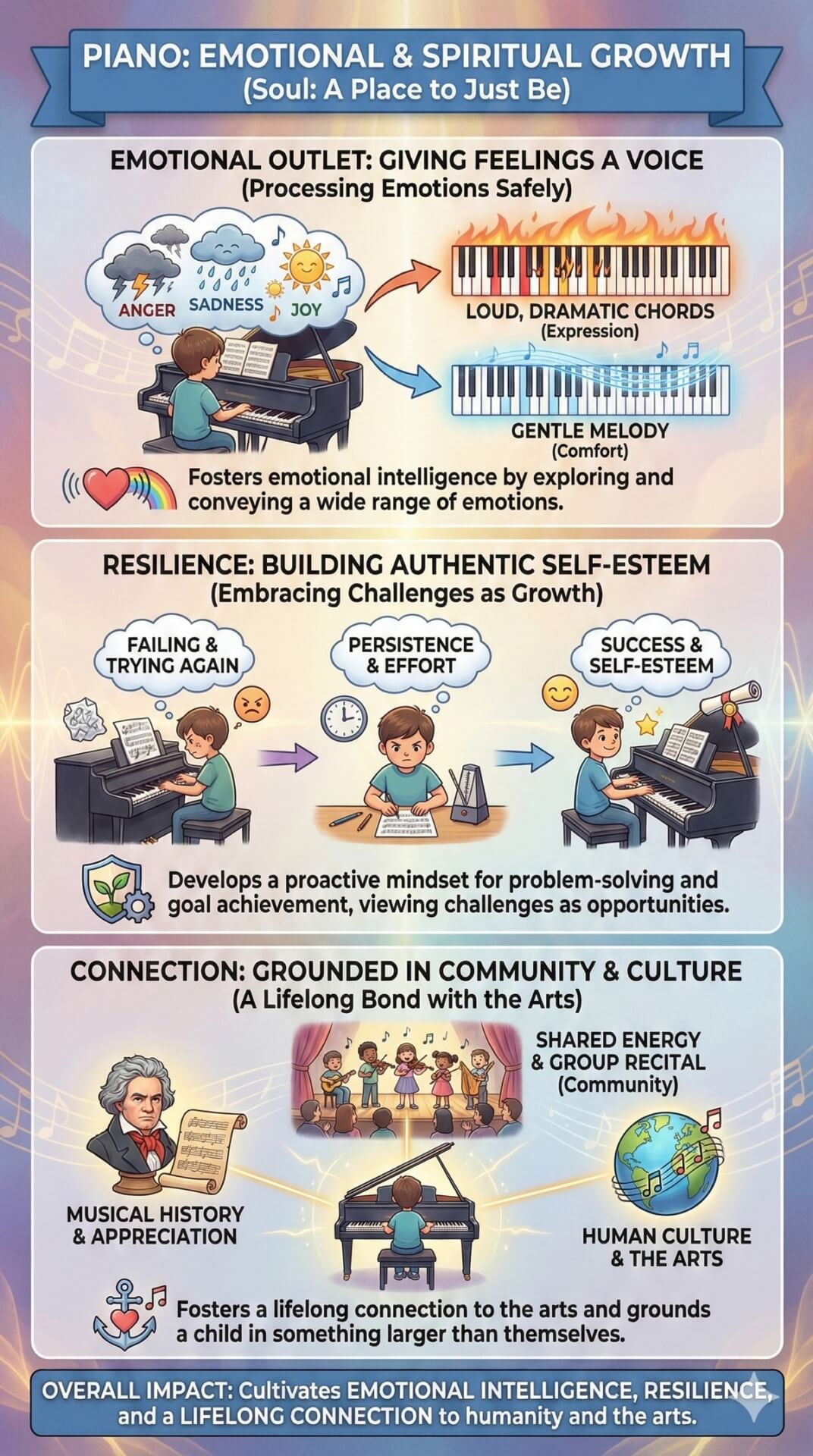
Emotional outlet: Children have big feelings but often lack the words to express them. The piano gives them a voice. Pounding out a loud chord or playing a gentle melody helps them process anger, sadness, or joy safely. Through music, children can explore and convey a wide range of emotions, fostering emotional intelligence.
Resilience: Learning an instrument is hard. It requires failing, trying again, and eventually succeeding. This builds deep, authentic self-esteem. Children learn to view challenges as opportunities for growth, a mindset that prepares them for future obstacles. The resilience developed through piano practice encourages a proactive approach to problem solving and goal achievement.
Connection: Music connects us to something larger than ourselves. Whether it’s the history of a classical composer or the shared energy of a group recital, it grounds a child in human culture and community. Piano education introduces children to a rich world of musical history and appreciation, fostering a lifelong connection to the arts.
The Holistic Choice
Piano isn’t just an extracurricular activity. It’s a comprehensive development programme disguised as fun. It builds a strong body, a sharp mind, and a resilient soul.
Learning in a group promotes holistic development by combining musical skills with social, emotional, and cognitive growth. The collaborative nature of lessons helps children develop empathy, patience, and resilience, which are essential life skills. This holistic approach to learning nurtures a well-rounded and adaptable mindset, preparing children to tackle diverse challenges with enthusiasm and curiosity.
Nurture your child’s complete development, body, mind, and soul. Explore our holistic piano classes at Little Play Space and give your child the gift of an activity that truly develops the whole person.